By Elad, One Stop Moving & Storage · Updated October 2026
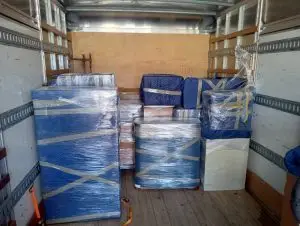
To load a storage container, put the heaviest things on the floor against the back wall, spread evenly from side to side. Then build tight walls of furniture and boxes from floor to ceiling, one section at a time, working toward the doors. Fill every gap, brace each finished section against the side walls, and finish with a flat wall at the doors before you lock up.
At One Stop Moving & Storage, our crews load portable storage containers for San Diego County homes every week, and we rent the containers too. Ours sit at ground level on your driveway, so there’s no ramp to push a dolly up. The method is the same whether your container stays put for a remodel or travels sealed to our facility or your next address. If it’s going to move, pack it like it will, because everything inside travels with it.
What do I need before the container arrives?
You need a plan for what goes in, the right supplies, and a clear path from your door to the container. Gather these first:
- Moving boxes in a few matching sizes. Every One Stop container comes with 25 free moving boxes to start.
- Furniture pads or moving blankets, and stretch wrap
- Packing tape, a marker and zip-top bags for screws and hardware
- Mattress bags or breathable covers
- A dolly or hand truck for heavy boxes and appliances
- A padlock of your own
Measure the big pieces, like the sofa, dresser and headboard, and check them against the container’s door opening. Ask us for the door measurements when you reserve. If a piece won’t fit through, take it apart now, not on loading day.
How do I get furniture ready to load?
Take apart anything with legs, rails or a frame: bed frames, dining tables, desks and shelving. Put the screws and bolts in a labeled bag and tape it to the piece it came from. Wrap wood and upholstered furniture in pads and hold the pads on with stretch wrap. Don’t put plastic wrap straight onto wood or leather you’re storing for more than a few weeks, because plastic traps moisture against the surface. Pads first, wrap over the pads.
Empty dressers and desks of anything heavy or breakable. Drawers left full make a piece too heavy to lift safely and can slide open in transit.
How should I pack the boxes?
Pack heavy things in small boxes and light things in large ones. A small box of books is easy to carry and stack. A large box of books is too heavy to lift and tends to split. Keep every box under about 50 pounds.
Use matching box sizes wherever you can. Boxes of the same size stack into straight, stable walls, which is the whole point in a container. Fill each box to the top so it doesn’t crush when another box sits on it, and label each one on two sides with the room and a short list of what’s inside.
What goes in the container first?
The heaviest, sturdiest items go in first, on the floor, against the back wall. That means appliances, dressers, solid wood furniture, toolboxes and boxes of books. Spread that weight evenly from left to right so one side doesn’t carry the load.
Our crew moves loaded containers by forklift onto a special tow bed, so a load that’s heavy at the back and balanced side to side travels well. What matters most is that nothing heavy sits loose up high or leans to one side.
How do I stack everything so nothing shifts?
Build the load in tiers. Each tier is a wall of furniture and boxes that runs from the floor to near the ceiling and across the full width of the container. Finish one tier completely before you start the next.
- Heavy on the bottom, light on top. Sturdy boxes and furniture form the base. Lighter boxes, lamps and fragile pieces go on top.
- Mix furniture and boxes. Slide boxes into the space under a table or inside a bookcase. Mixed tiers lock together better than a stack of boxes next to a stack of furniture.
- Stand long, flat items on edge. Mattresses, box springs, tabletops, headboards and mirrors stand upright against the side walls, in their covers.
- Sofas go on end if they’re light enough. Standing a sofa on its end saves floor space. Wrap it first and protect the end it stands on.
- Leave a little room at the top. Keep a few inches clear between the top of each stack and the ceiling.
How do I fill the gaps?
Pack every empty space with something soft: pillows, cushions, bags of linens, rolled towels or clothing in bags. Gaps are where things fall and break. When you push on a finished tier, it shouldn’t move.
How do I keep the load from shifting without tie-downs?
Build each tier tight to both side walls and brace it. One Stop containers don’t have interior tie-down rails, so the load holds itself in place: pack each tier wall to wall, fill the gaps, and stand a mattress or a row of same-size boxes against the face of each finished tier so it can’t lean.
Even if your container is staying on the driveway, a braced last tier keeps the load from leaning toward the doors. That matters on the day you open them.
How should I finish at the doors?
Finish with a flat, solid wall: a mattress in its bag, a box spring or a row of same-size boxes, pressed tight against the tier behind it. That keeps anything from tipping out when the doors open.
If the container is staying at your home and you’ll need things from it, load those last, right inside the doors. Holiday decorations, tools for the remodel and the kids’ summer gear should be the first things you reach, not buried at the back.
How do I lock and protect the container?
Close the doors fully and lock them with your own padlock. One Stop’s steel containers take your own lock, so the only key is yours. A disc lock or a padlock with a shrouded shackle is harder to cut than a standard padlock.
Our containers are steel, weather sealed and ventilated, but they are not climate controlled. Near the coast, damp air from the marine layer is the bigger risk than rain. Load on a dry day, and if mornings are foggy where you live, wait until the afternoon clears. Put moisture absorbers in the corners for longer stays. Keep clothing, linens and paper in plastic bins rather than cardboard. Anything that heat or humidity would damage, like fine wood furniture, artwork, photos or electronics stored for months, is better off in our climate-controlled vault storage. Our guide to what a portable storage container is explains what the containers do and don’t protect against.
What should I not pack in a storage container?
Keep out anything that can burn, leak or spoil. That includes gasoline, propane tanks, paint thinner, cleaning chemicals, ammunition and food. Drain gas and oil from mowers and other small engines before you load them.
Keep the things you can’t replace with you, not in the container: passports, birth certificates, financial papers, medications, jewelry, laptops and anything you’ll need in the next few weeks.
How much fits in a container?
It depends on the size. One Stop rents two:
| Size | Dimensions | Capacity | Usually fits |
|---|---|---|---|
| Standard | 5 × 8 × 8 ft | 320 cu ft | One to two rooms, or a studio |
| Large | 7 × 8 × 8 ft | 448 cu ft | A one bedroom apartment, for example a sofa, a queen mattress and frame, a dresser, a dining set and about 30 medium boxes |
If a Large looks tight, two containers fit on a standard two-car driveway, and one can go sealed to our facility while the other stays for the things you still need. Our container sizes guide has the full comparison.
Should I load it myself or hire a crew?
Load it yourself if you have time, help and a few days. Book a crew if you have heavy furniture, stairs, a long walk to the driveway or a fixed move date. With a One Stop container you can load over an afternoon or over three weeks; rentals run month to month. If you’d rather not lift anything, our storage container loading help sends One Stop’s own full-time movers, not subcontractors, quoted separately in writing before you book. Loading a container usually takes them about 2 hours, and the same crew can pack your boxes too, at the same rate.
Ready to load a container in San Diego County?
One Stop Moving & Storage delivers steel portable storage containers anywhere in San Diego County with 24 hours’ notice, from $99 a month, with delivery and pickup quoted in writing for your address. Keep it at home, have us store it sealed at our facility, or have us carry it to your new address in the county. If you’re moving, see how moving with a container works, or read about storage during a move in San Diego if your dates don’t line up. Before delivery, check the driveway rules for your city. Call (858) 633-8600 or get your price online.
Frequently asked questions
At the back, on the floor, spread evenly from side to side. Heavy items on the bottom give each tier a stable base, and keeping the weight balanced stops the load from shifting when the container moves.
Two One Stop movers usually load a container in about 2 hours, depending on stairs, the walk to the driveway and how much is already boxed. Loading help is quoted separately, in writing.
It’s still a good idea. A container that never moves won’t throw your things around, but a tall stack can lean over weeks and fall when you open the doors. Tight tiers and a flat, braced wall at the doors prevent that.
Yes. One Stop containers rent month to month and sit at ground level on your driveway, so you can load a room each evening. Start with the garage, spare room and off-season things, and leave the kitchen and everyday items for last.
Your own. A disc lock or a padlock with a shrouded shackle is harder to cut than a standard one. One Stop containers take your own padlock, so nobody else has a key.